
Why Choose Freeze Dried Raw Dog Food for Global Buyers?
For global buyers, Freeze Dried Raw Dog Food offers a practical way to explore raw-style nutrition with improved storage convenience. The process removes moisture at low temperatures, creating lightweight pieces that travel easily and require less refrigeration. A sealed pouch can fit into a warehouse, retail shelf, or family cupboard. That matters when supply chains cross borders.
Still, convenience should not replace careful judgment. Product quality depends on traceable ingredients, hygienic processing, accurate labeling, and responsible packaging. Buyers should review meat sources, nutrient profiles, batch records, and shelf-life testing before placing large orders. Reputable suppliers can explain how they manage pathogens, moisture control, and production consistency. They should also provide clear feeding guidance for different dog sizes and life stages.
Evidence can be uneven. Raw feeding is not a magic answer, and one formula may not suit every dog. Veterinary advice remains valuable, especially for puppies, older dogs, or animals with medical conditions. Global buyers must also check destination-country rules, import documentation, and approved ingredient requirements. A product that sells well in one market may need changes elsewhere. That detail is easy to miss.
The strongest choice combines convenience with accountability. Buyers should ask difficult questions. Can the supplier prove origin? Are safety controls independently reviewed? Is the packaging suitable for humid climates? Freeze Dried Raw Dog Food can support international growth, but trust is built through transparent evidence, not attractive claims. Mistakes happen. Responsible brands learn from them.
What Is Freeze-Dried Raw Dog Food?
Why Choose Freeze-Dried Raw Dog Food for Global Buyers?
What Is Freeze-Dried Raw Dog Food?
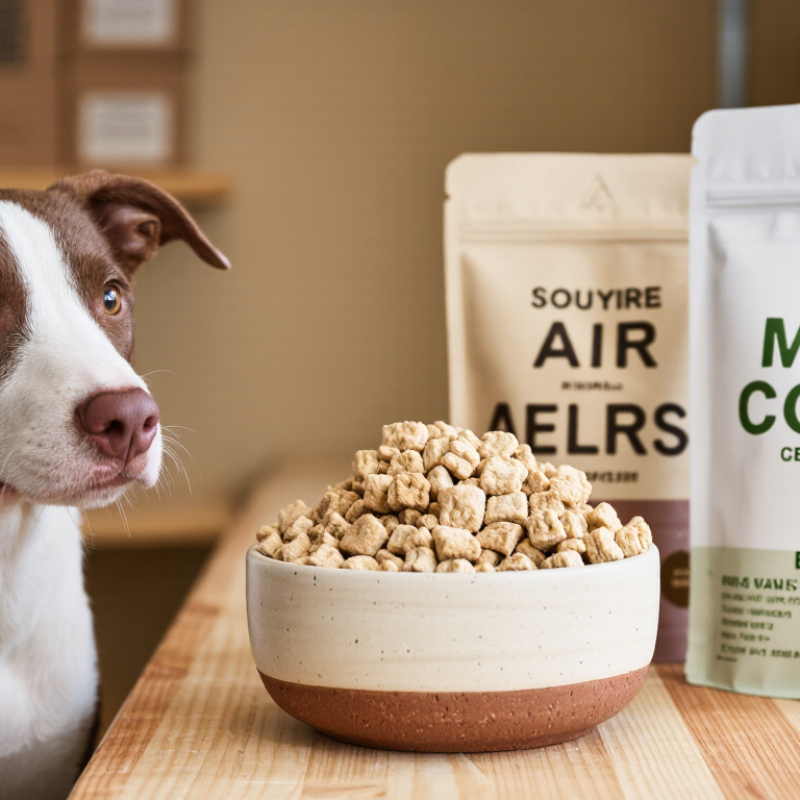
Freeze-dried raw dog food is made from uncooked animal ingredients, vegetables, and approved nutrients. The mixture is frozen, then placed in a vacuum chamber. Ice leaves as vapor, while much of the original shape, aroma, and flavor remains. It is not the same as cooked food. It is also not simply dehydrated kibble.
The process removes most moisture, making the product lighter and easier to store without refrigeration. Buyers can add clean water before serving, often restoring a soft, meat-like texture. However, freeze-drying does not guarantee sterilization. The U.S. Food and Drug Administration found Salmonella in 15 of 196 tested raw pet food samples, while 32 contained Listeria monocytogenes. That finding still matters for handling and household hygiene.
Food safety depends on more than the processing method. Reliable producers should verify ingredient suppliers, batch testing, traceability, and storage conditions. FEDIAF nutritional guidelines can help assess balanced formulation, but they do not replace local regulatory checks. Global buyers should also review moisture, crude protein, feeding directions, and rehydration instructions.
The details can be inconvenient.
In practice, some owners underestimate cross-contamination risks around bowls, hands, and kitchen surfaces. I would not treat “raw” as automatically superior. The better question is whether the product is nutritionally complete, professionally controlled, and suitable for the dog’s age, health, and daily routine.
Why Choose Freeze-Dried Raw Dog Food for Global Buyers? - What Is Freeze-Dried Raw Dog Food?
Key product characteristics, handling requirements, and buyer considerations for freeze-dried raw dog food
| Data Dimension | Typical Information | What It Means for Global Buyers | Important Considerations |
|---|---|---|---|
| Product Definition | Raw animal ingredients are frozen and placed under vacuum so ice changes directly from solid to vapor. | The process removes water while retaining the product's original structure more effectively than many conventional heat-drying methods. | Freeze-drying does not make raw ingredients sterile and should not be treated as a substitute for food-safety controls. |
| Moisture Content | Finished products commonly contain approximately 2%–5% moisture, although specifications vary by recipe and process. | Low moisture reduces weight and helps support ambient distribution when the package remains sealed. | Buyers should verify the product specification, water activity, and packaging performance rather than relying on moisture percentage alone. |
| Rehydration | Food can be served dry or mixed with clean water according to the feeding instructions. | Rehydration can improve palatability and increase water intake, which is useful in different climates and feeding environments. | Once rehydrated, handle the food as a perishable product and follow the stated time and temperature guidance. |
| Ingredient Profile | Recipes may include meat, poultry, fish, organs, edible bone or mineral sources, and plant ingredients such as vegetables or fruits. | Ingredient lists are easy to compare across markets and can support product positioning around animal-based nutrition. | A complete diet should be formulated to meet the nutritional needs of the intended life stage. “Raw” alone does not prove nutritional adequacy. |
| Protein and Fat | Because water is removed, protein and fat percentages appear higher on an as-fed label than in a high-moisture food. | Buyers should compare products on a dry-matter basis for a more meaningful nutritional comparison. | Energy density can be high, so feeding quantities should be based on calories, body condition, and the dog's activity level. |
| Storage Before Opening | Many products are designed for storage at room temperature in a cool, dry place while unopened. | Ambient storage can simplify international shipping, warehousing, and retail display compared with frozen raw food. | Storage requirements depend on the validated shelf-life study, package barrier properties, temperature, humidity, and seal integrity. |
| Typical Shelf-Life Considerations | Commercial shelf life is product-specific and is commonly established through stability testing rather than a universal industry period. | Longer validated shelf life may reduce waste and make long-distance supply planning easier. | Check the manufacturing date, best-before date, lot code, oxygen-control system, and post-opening instructions. |
| Packaging Requirements | Moisture- and oxygen-barrier pouches, trays, or bags are commonly used, often with a secure heat seal. | Effective packaging helps protect texture, aroma, nutrients, and microbiological quality during transport. | Packaging should be evaluated for puncture resistance, seal strength, labeling compliance, and suitability for the destination climate. |
| Shipping Profile | Low water content generally produces a lighter product than frozen raw food with comparable feeding value. | Lower shipping weight and no routine frozen transport can improve logistics flexibility for international buyers. | Products must still be protected from excessive heat, humidity, crushing, and prolonged exposure after package damage. |
| Food-Safety Risk | Raw animal ingredients may contain pathogenic microorganisms, including Salmonella, Listeria, or certain strains of Escherichia coli. | Buyers need confidence in supplier controls, testing programs, traceability, and recall procedures. | Good manufacturing practices, hazard-based controls, validated processing, sanitation, and clear handling instructions are essential. |
| Handling After Opening | Opened product should be resealed tightly and stored according to the package instructions; rehydrated food requires more stringent handling. | Clear instructions reduce consumer error across different countries and household practices. | Use separate utensils, wash hands and surfaces, and avoid leaving rehydrated food at room temperature for extended periods. |
| Feeding Format | Available as patties, nuggets, bites, crumbles, or complete-meal portions. | Different formats can support portion control, convenience, travel use, and varied retail channels. | Portion size should match the dog's weight, age, activity, health status, and the food's calorie density. |
| Regulatory Documentation | International shipments may require ingredient declarations, guaranteed analysis, feeding guidelines, lot identification, country-of-origin details, and health or export documents. | Complete documentation can reduce customs delays and support compliant market entry. | Requirements differ by destination. Importers should confirm rules with the relevant veterinary, food, and customs authorities before shipment. |
| Best Use Case | Suitable for buyers seeking a lightweight, shelf-stable format with raw-style ingredients and flexible preparation. | The format can serve pet retailers, distributors, travel customers, and households with limited freezer space. | It may not be appropriate for every dog, especially those with specific medical or dietary needs. Veterinary advice may be necessary. |
| Note: Values and practices shown are general industry information. Exact nutritional composition, shelf life, storage conditions, microbiological controls, and import requirements must be confirmed from the product specification, laboratory documentation, and regulations of the destination market. | |||