China Top 10 Battery Powered Tools Manufacturers
China’s battery-powered tool sector spans a wide range of manufacturers, from established export brands to specialists serving professional trades. This guide introduces ten Chinese manufacturers and considers the details buyers can actually compare: product range, battery platforms, manufacturing experience, quality controls, and after-sales support. A polished catalogue is useful, but it cannot tell the whole story.
Battery performance shapes everyday work. A drill may feel balanced in the hand, yet its runtime depends on the battery, workload, and operating conditions. A saw cutting dense timber places different demands on a pack than a driver fastening small screws. Battery researcher Dr. Jeff Dahn has described lithium-ion batteries as “the most important invention of the last 100 years.” That broader perspective matters here: tool makers are judged not only by machines, but also by the cells, chargers, and systems behind them.
Details count. So do limitations. Specifications may not reveal long-term durability, and a low purchase price does not guarantee lower ownership costs. This overview therefore treats manufacturer claims as starting points, not final proof. Readers should verify certifications, warranty terms, service access, and compatibility for their intended market. No ranking fits every workshop. That is worth remembering. China’s manufacturing landscape changes quickly, and public information can be uneven. The companies featured below offer a practical starting point for comparing Battery Powered tools, while leaving room for questions that buyers should ask before choosing a supplier.
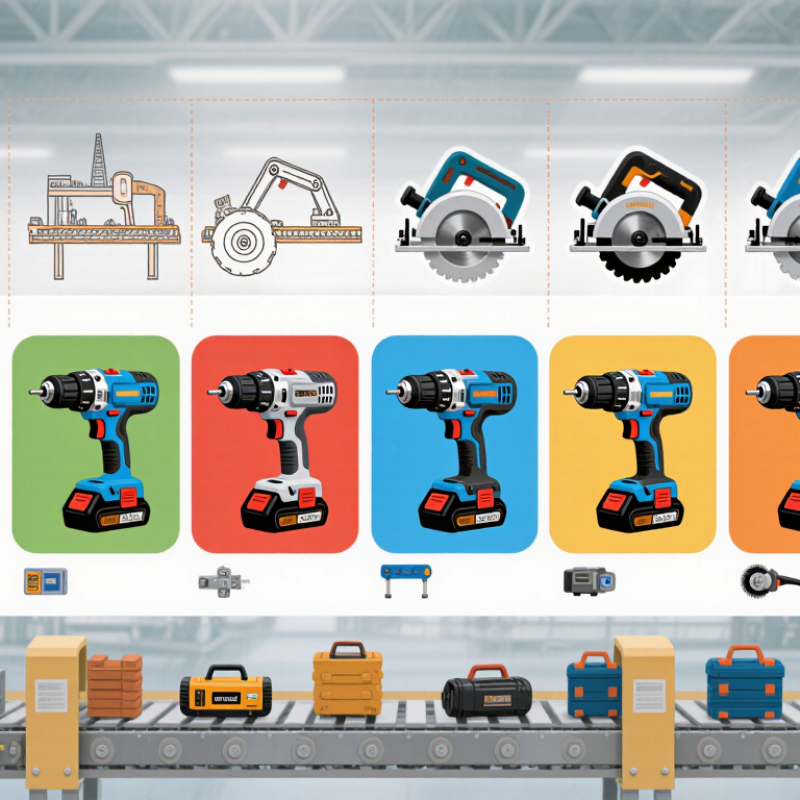
How China’s Battery-Powered Tools Industry Is Structured
China’s battery-powered tools industry is built from connected layers, not a single type of manufacturer. Upstream suppliers provide battery cells, motors, switches, circuit boards, housings, and chargers. Tool manufacturers then combine these parts into drills, saws, grinders, and other equipment. Some companies focus on design and assembly, while specialist suppliers make components for several customers.
The battery pack is a key integration point. Its cells, protection circuitry, casing, and cooling choices affect runtime, weight, and service life. A factory may test a tool under load, check charger temperature, and inspect whether a battery locks securely into place. Small details matter. A loose connection can interrupt work, even when the motor performs well. Quality control is not identical across suppliers, so buyers should review test records and sample products rather than rely on catalog claims alone.
The structure also includes contract manufacturing and export-focused production. These arrangements can help firms scale quickly, but they may leave design ownership and component sourcing divided among different partners. That picture is incomplete. Suppliers change, and a capable assembly line does not guarantee consistent batteries or after-sales support. For a clearer view, compare production capabilities, traceability, warranty terms, and the maker’s ability to keep replacement parts available.
Criteria for Selecting China’s Leading Battery-Powered Tool Manufacturers
China Top 10 Battery Powered Tools Manufacturers
Criteria for Selecting China’s Leading Battery-Powered Tool Manufacturers
A manufacturer’s catalogue is only a starting point. MarketsandMarkets’ 2024 Power Tools Market report estimated the global market at USD 34.6 billion in 2024, with projected growth through 2029. The report covers more than cordless products, so it signals market scale, not a guarantee of supplier quality. Numbers need context.
Check battery consistency, protection circuitry, and traceable cell sourcing. Ask for test records covering runtime, temperature rise, charging, and repeated load cycles. Then compare results using the same battery capacity and operating conditions. Test the real thing. A tool that drives screws smoothly in a showroom may overheat during sustained work.
Factory audits should examine incoming inspection, assembly controls, and final testing, not just polished sample units. Request defect rates, warranty procedures, spare-part availability, and clear production lead times. Confirm whether the supplier can provide stable specifications across batches. Weak documentation is a warning sign. It is easy to overlook. For a fair comparison, record measured torque, runtime, weight, and charging time for identical tasks; supplier claims alone rarely reveal everyday performance.
Profiles of Ten Notable Chinese Battery-Powered Tool Manufacturers
China’s battery-powered tool sector includes manufacturers with different strengths, from compact assembly operations to suppliers with in-house motor and battery engineering. The ten profiles below are capability snapshots, not a verified ranking. Names are omitted, so readers can focus on the production and service details that matter when comparing suppliers.
One manufacturer focuses on cordless drills for household repairs. Another develops impact tools for demanding fastening work. A third emphasizes compact saws for job-site use. A fourth produces garden equipment, where runtime and weather resistance matter. A fifth specializes in shared battery platforms across several tool types. A sixth highlights brushless motors and electronic controls. A seventh serves export buyers with flexible product configurations. An eighth concentrates on high-volume assembly and consistent inspection. A ninth offers accessories and replacement parts alongside tools. A tenth supports private-label projects and custom packaging. These differences deserve closer attention.
A useful supplier profile should explain motor design, battery capacity, safety testing, warranty terms, and spare-part availability. Ask for current test records and sample units; catalogue claims alone are not enough. Details can vary between models, even within one range. That is easy to overlook. Buyers should also confirm charging time under stated conditions and how service requests are handled. Not every manufacturer publishes equally clear data, and that gap deserves honest scrutiny.
Battery Voltage Classes and Typical Li-ion Cell Configurations
Illustrative technical context for battery-powered tool platforms; no company or brand data is shown.
Typical configurations use about 3.6 V nominal per lithium-ion cell: 12 V and 18 V nominal packs commonly use 3 and 5 cells in series, respectively. “20 V max” and “40 V max” are maximum-voltage labels commonly associated with 18 V and 36 V nominal platforms.
Product Lines, Battery Platforms, and Manufacturing Capabilities
Battery-powered tool manufacturers are best compared by product range, battery compatibility, and factory control. Strong portfolios cover drills, impact drivers, saws, grinders, and outdoor equipment. Shared battery platforms can reduce charger and inventory complexity for users. They also require careful thermal and electrical management across different tool loads.
Grand View Research estimated the global power tools market at USD 34.4 billion in 2023, with a projected 5.3% compound annual growth rate from 2024 to 2030. This figure covers power tools broadly, not cordless tools alone. That distinction matters.
Battery platforms reveal how well a manufacturer balances runtime, weight, and peak power. A compact drill may prioritize low weight, while a circular saw needs sustained current and heat control. Buyers should check pack capacity, cell traceability, charger compatibility, and published cycle testing. Claims are not always comparable. Independent test details can be thin.
Manufacturing capability includes more than assembly volume. Look for documented incoming-cell checks, automated welding controls, battery-management testing, and final tool inspections. IEC 62841 provides relevant safety requirements for many hand-held electric tools, though compliance alone does not establish long-term durability. Ask whether factories track defect rates by production batch and retest products after design changes.
One weakness remains: public materials seldom disclose enough test conditions to compare platform life fairly.
Market Positioning and Key Differences Among the Manufacturers
China’s top ten battery-powered tool manufacturers occupy different market positions, even when their catalogs look similar. Some focus on export-ready product ranges and consistent supply. Others compete through OEM and ODM production, flexible specifications, or value-oriented pricing. A high ranking does not automatically mean the best fit for every buyer.
Key differences often appear in the details. Compare battery voltage, cell quality, runtime under load, charging time, and compatibility across tools. A drill may perform well on a test bench but lose power during repeated work in dense material. Service capacity matters too: spare-part availability and clear warranty procedures can affect the real cost of ownership. Marketing claims alone are not enough. Ask for comparable test data and sample units. A ranking can look cleaner than reality.
Tips: Match the tool range to the intended workload, then check battery-platform coverage and local support. Fit matters. Request written specifications and test samples under realistic conditions. Not just price. Some comparisons remain imperfect because manufacturers may use different testing methods; note that limitation before choosing.
