
How to Source Biomass Leather in 2026?

In 2026, sourcing Biomass Leather begins with a simple question: what, exactly, is the biomass? The label can describe materials made from agricultural residues, plant matter, or microbial growth, but it does not guarantee a consistent recipe. A glossy swatch may feel convincing. Its backing, coatings, and binders still need scrutiny.

Biofabricate founder Suzanne Lee asked, “What if we could grow our clothes?” That question captures the promise, not proof of performance. Buyers should request clear feedstock descriptions, ingredient breakdowns, batch traceability, and independent durability results. Ask how the material handles abrasion, moisture, heat, and repeated flexing. Then compare those results with the intended product, whether it is a handbag, shoe upper, or furniture panel.

Look beyond the sample. Request evidence for environmental claims, including the assessment method and its boundaries. Ask suppliers how much biomass is used and whether the finished material contains synthetic components. Not every supplier will share every detail. That is a sourcing risk worth recording, not smoothing over.

A short supplier checklist helps: feedstock origin, processing steps, composition, testing, minimum order quantities, and production capacity. If possible, inspect a production batch rather than relying only on a showroom swatch. Biomass Leather is an evolving category, and terms can be used differently across suppliers. I would not treat one certification or one attractive sample as a complete answer. Verify the evidence, note what remains uncertain, and revisit the decision as specifications and supply chains change.
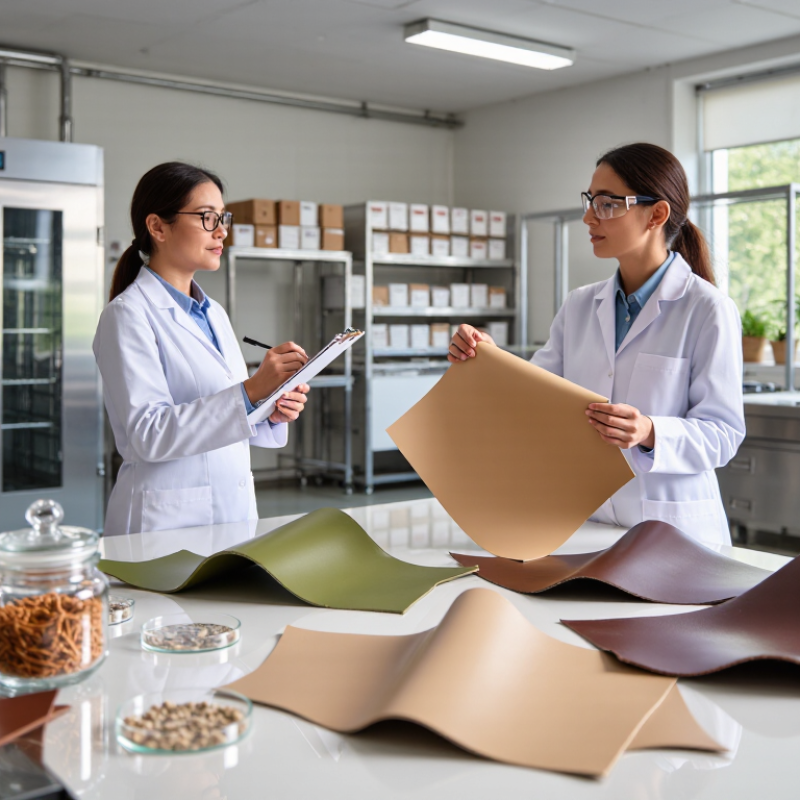
How to Source Biomass Leather in 2026?

What Biomass Leather Is and How It Differs from Conventional Leather

Biomass leather is a broad term for leather-like materials made partly from biological sources. These may include agricultural residues, plant fibers, or fungal mycelium. The material is usually combined with binders, backing fabrics, and surface coatings. So “biomass-based” does not automatically mean fully plant-derived or biodegradable. Check the full composition.

Conventional leather is made from animal hide, whose collagen structure gives it distinctive strength and flexibility. Biomass alternatives vary more widely: one may feel soft and grainy, while another feels smooth and slightly plastic-like. Their durability depends on the recipe, construction, and finish—not just the feedstock. Ask suppliers for test data on abrasion, flexing, water exposure, and aging. A natural-looking surface can still crack after repeated bending. That detail is easy to overlook.

Tips: Request a material specification and a sample from the same production batch. Confirm the percentage and source of biomass, plus the type of backing and coating. Compare samples under real use, such as rubbing them against a bag strap or wiping them with a damp cloth. Claims about lower environmental impact need evidence across the material’s full life cycle. Some data may be incomplete. That deserves a careful question, not a quick assumption.

Which Biomass Feedstocks Are Used in Leather Alternatives

In 2026, biomass leather can begin with very different feedstocks: pineapple leaves, apple pomace, grape marc, cactus pulp, cereal straw, or mycelium grown on crop residues. Feedstock choice affects texture, color, and supply reliability. Leaf fibers may remain visibly strand-like; fruit residues usually need drying and grinding. Not every waste stream behaves alike.

UNEP’s Food Waste Index Report 2024 estimates that 1.05 billion tonnes of food waste were generated in 2022. That figure includes household, food-service, and retail waste; it is not an estimate of material available for leather alternatives. The FAO’s The State of Food and Agriculture 2019 reports that 14% of food is lost between harvest and retail. That distinction matters. Loss figures do not tell buyers how much clean, consistent residue can actually be collected.

For sourcing, check moisture, seasonal volume, contamination, transport distance, and existing uses such as animal feed or compost. Ask what share of the finished sheet is biomass, and what binders or coatings hold it together. A high residue percentage can still hide a fragile supply chain. Small pilot batches help reveal odor, cracking, and color variation before larger orders. Some figures remain hard to compare because suppliers define “biomass content” differently.

How to Source Biomass Leather in 2026? Which Biomass Feedstocks Are Used in Leather Alternatives?

Selected crop production worldwide, 2022 (million tonnes). These crops are associated with residues used in some leather-alternative materials; crop output is a sourcing-context proxy, not the quantity of residue available for processing.

How to read this: Banana pseudostems, pineapple leaves, apple pomace, and grape pomace can provide biomass for material development. Actual sourcing potential depends on residue yield, local collection, competing uses, and processing infrastructure. The figures show total crop production, not residue volumes.

Source: FAOSTAT, Crops and livestock products, 2022 data; values rounded to the nearest million tonnes. Feedstock examples refer to agricultural residues associated with these crops.

How Biomass Leather Is Manufactured and Finished

Biomass leather usually begins with plant-based material such as agricultural residues, fibers, or oils. The feedstock is cleaned, dried, and processed into a usable powder, pulp, or liquid. Its origin matters: moisture, fiber size, and seasonal variation can affect consistency. The category is not perfectly standardized. Ask suppliers what “biomass content” means and whether it refers to the finished sheet or one ingredient.

Manufacturers combine prepared biomass with binders and other formulation ingredients, then spread or cast the mixture onto a textile backing. Some processes use several thin layers rather than one thick coat. The sheet is dried or cured under controlled heat, then pressed or embossed to create grain and surface texture. Details matter. A sharp, repeated pattern may look convincing, but appearance alone cannot show how the material will wear.

Finishing can include coloring, protective topcoats, and adjustments to softness or sheen. These treatments influence abrasion resistance, flexibility, and cleanability, so request test results tied to the intended use. Check thickness across the roll, surface adhesion, odor, and performance after flexing. Not every batch behaves alike. I would also request a sample from a production run, not just a polished showroom swatch; that extra check can reveal uneven color or a coating that feels different at the edges.

How to Source Biomass Leather in 2026? — How Biomass Leather Is Manufactured and Finished
Sourcing or production dimension What to verify How it is manufactured or finished Practical evaluation
Material definition Ask for the full material composition by layer, including the biomass-derived fraction, polymer binders, textile backing, coatings, and any additives. “Biomass-based” does not by itself mean plastic-free, biodegradable, or equivalent to animal leather. Many materials marketed as biomass leather are composites: biomass-derived ingredients are processed into a sheet or coating and combined with a backing and, in some cases, synthetic or bio-based polymers. Request a current bill of materials and clarify whether stated bio-based content applies to the whole product or only one layer. Check the method used to substantiate bio-based content, such as radiocarbon testing where appropriate.
Feedstock and origin Identify the actual input—such as agricultural residues, fruit-processing by-products, plant fibers, or fungal biomass—and document its geographic origin, supplier, and chain of custody. Depending on the technology, biomass may be cleaned, dried, milled, separated into useful fractions, or grown as a structured fungal material before sheet formation. Request evidence that the feedstock is available at the required scale and is consistently specified. Distinguish true residues or by-products from purpose-grown crops, and check for competing uses.
Input variability Confirm how the supplier controls moisture, particle size, fiber or solids content, contamination, and seasonal variation in the feedstock. Incoming biomass is typically inspected and conditioned before blending or forming. Formulation adjustments may be needed to manage variation and achieve consistent sheet properties. Review incoming-material specifications, batch records, and change-control procedures. Request samples from more than one production batch rather than assessing a single hand sample.
Sheet formation and binder system Ask how the biomass is incorporated into the sheet and identify the binder or matrix. Obtain the proportion of biomass in the finished material and the basis for any percentage claim. Common routes include blending biomass-derived particles or fibers with a binder and forming a sheet, applying a formulated layer to a backing, or growing and consolidating fungal structures. Routes differ by material and are not interchangeable. Check thickness, weight per area, surface uniformity, and bonding between layers. Ask whether production-scale material uses the same formulation and process as the sample.
Backing and construction Identify the backing fiber and its composition, construction, and attachment method. Determine whether the backing can be separated for repair, recycling, or end-of-life processing. A backing may be laminated or coated to provide support, dimensional stability, or a textile-like feel. The backing can materially affect performance and the overall product’s bio-based content. Assess the complete composite, not just its visible face. Request layer-by-layer composition and evaluate delamination, edge behavior, and compatibility with the intended sewing or bonding process.
Finishing and surface treatment Request disclosure of topcoats, pigments, embossing, waxes, and other surface treatments, along with relevant chemical-safety documentation. Finishing may include color application, surface coating, embossing, texture creation, or protective treatment. It is used to adjust appearance and resistance to abrasion, staining, or moisture. Compare finish options for color consistency, feel, flexibility, and coating adhesion. Ask whether the finish changes the material’s composition claims or limits recycling options.
Performance testing Set application-specific acceptance criteria before ordering. Performance requirements vary substantially between footwear, upholstery, bags, apparel, and other uses. Testing evaluates the finished composite and should reflect its intended use, construction, and exposure conditions—not just the uncoated biomass ingredient. Consider tensile and tear strength, flex resistance, abrasion, coating adhesion, colorfastness, and hydrolysis or aging where relevant. Use recognized methods appropriate to the material type, such as applicable coated-fabric or leather test methods, and agree on conditioning and sample direction.
Chemical and claim verification Obtain safety data and relevant restricted-substance test results for the finished article. Check that environmental claims are precise, substantiated, and specific to the tested product. Feedstock origin alone does not establish the chemical profile or environmental performance of the finished composite; binders, pigments, coatings, and processing aids also matter. Request test reports from competent laboratories and verify their scope, sample identity, and date. For environmental marketing claims, review applicable rules in each sales market and avoid unsupported claims such as “plastic-free” or “biodegradable.”
Traceability and supply continuity Confirm the production site, manufacturing capacity, lead times, minimum order quantities, quality controls, and notification process for changes in feedstock or formulation. Biomass inputs can depend on agricultural or food-processing supply chains, while finished-sheet production may involve separate compounding, coating, or lamination operations. Request a traceability record linking feedstock lots to finished batches, a documented specification, and a contingency plan for seasonal or supplier disruptions.
Pilot order and approval Agree on a written specification, approved reference sample, tolerances, color standard, test plan, and procedures for nonconforming material before placing a production order. Scale-up can affect thickness, texture, color, flexibility, and surface quality. A laboratory sample may not represent a continuous production run. Approve a production-representative sample and retain a sealed reference. Evaluate sewing, cutting, bonding, forming, and finishing using the same processes planned for the final product.

How to Evaluate Performance, Traceability, and Environmental Claims

How to Source Biomass Leather in 2026?
How to Evaluate Performance, Traceability, and Environmental Claims

A biomass percentage is only a starting point. Ask suppliers to define what it measures: plant-derived content, total dry mass, or one layer in a coated composite. Request test results for the finished material, not just its base sheet. Check tensile strength, abrasion, repeated flexing, colorfastness, and hydrolysis resistance against your product’s actual use. For footwear, for example, ask how the material behaves after repeated bending and damp storage. Small samples can mislead.

Trace each input back to its source. Request batch-level records for feedstock, processing locations, additives, and backing fabrics, then compare them with invoices or chain-of-custody documents. The Textile Exchange 2024 Materials Market Report estimates global fiber production reached 124 million tonnes in 2023. That scale makes clear sourcing records important, but it does not prove any individual material is responsible. Paperwork can be incomplete.

Treat environmental claims as questions, not headlines. Ask for a life-cycle assessment that names its functional unit, system boundaries, energy mix, and allocation method. ISO 14040 and ISO 14044 provide established LCA principles. The FAO’s 2013 assessment attributed 14.5% of human-caused greenhouse gas emissions to livestock supply chains; that figure is context, not proof that a particular leather alternative performs better. Biomass content alone is not an impact result. One uncomfortable gap may remain: comparable, independently verified data are not always available. State that plainly, and avoid claims the evidence cannot support.

How to Find, Assess, and Qualify Biomass Leather Suppliers in 2026

In 2026, sourcing biomass leather starts with a clear material brief, not just a supplier list. Specify the feedstock, intended use, target thickness, backing, finish, and expected annual volume. Ask suppliers to map every layer, including binders and coatings; “plant-based” alone does not describe the full construction. Request traceability records linking feedstock to production batches. Small details matter.

Request swatches from multiple production lots, then compare color, grain, odor, flexibility, and edge behavior under consistent conditions. Ask for test reports covering abrasion, tear strength, hydrolysis, and relevant chemical content. Confirm the test methods, dates, and sample identity; a report without these details is difficult to interpret. Check certifications carefully, including which facility and product they cover. A beautiful swatch proves very little.

Before qualifying a supplier, discuss capacity, lead times, minimum order quantities, change control, and defect handling. Run a pilot order and inspect pieces from the beginning, middle, and end of production. Agree on written acceptance limits before ordering, then check consistency with a second production lot. If a supplier cannot disclose its full formulation, ask about material ranges and change notifications. Biomass content can vary with process and formulation, so record unanswered questions rather than treating them as settled.