
A Cotton Bed Cover may look simple on a showroom shelf, yet its comfort and durability depend on details buyers cannot judge by color alone. Fiber content, weave, fabric weight, finishing, and shrinkage all shape how a cover feels after repeated washing. Textile Exchange’s Materials Market Report 2024 estimated global fiber production at 124 million tonnes in 2023. That scale makes clear why buyers should ask specific questions about material origin and manufacturing, rather than relying on “natural” as a quality guarantee.
Cotton Incorporated’s vice president and chief sustainability officer, Dr. Jesse Daystar, has emphasized that cotton’s environmental impact should be considered across its production stages. In paraphrase, his point is that the fiber name alone does not tell the full story. Check what a supplier can document. Ask for fabric composition, tested dimensions, colorfastness results, and care instructions. For example, a cover that measures correctly before washing may still shrink enough to leave a mattress edge exposed. Small details matter.
This guide presents ten practical buying tips for global buyers, from comparing weaves to checking supplier samples and product specifications. Use recognized test methods and clear paperwork where possible. Labels can mislead. And one sample cannot prove every production batch will match. Treat it as a starting point, then verify the details that matter to your customers.
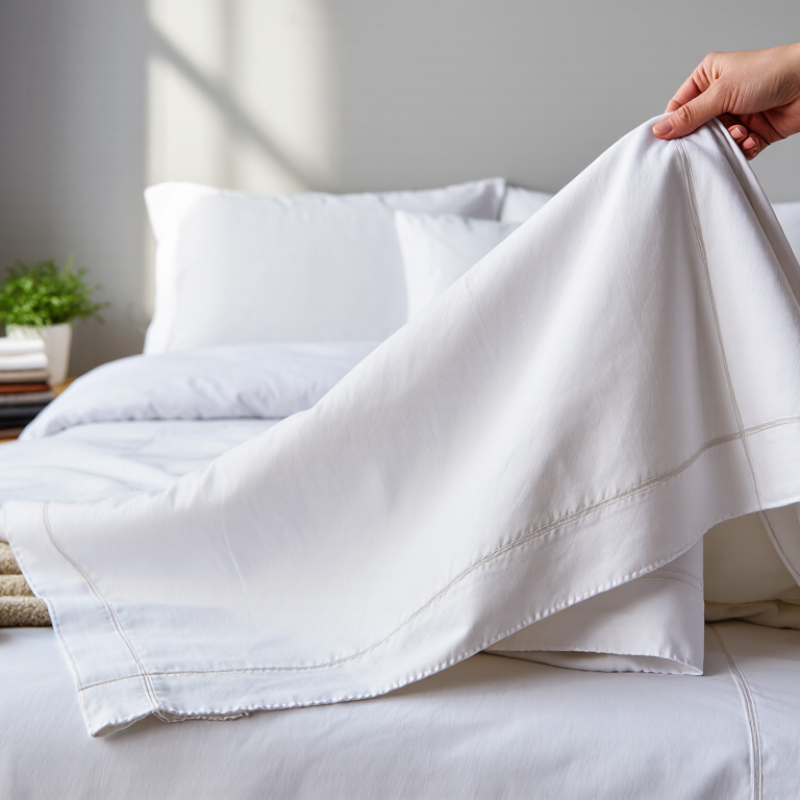
When comparing cotton bed covers, treat “organic” as a documented claim, not a description of softness or color. Under GOTS labeling criteria, a product labeled “organic” must contain at least 95% certified organic fibers. The remaining fiber content is not a free-for-all; it must meet the standard’s requirements. A fabric swatch cannot prove this. It may feel smooth and look natural, but appearance tells you little about fiber origin.
Tip: Ask for a current GOTS certificate and confirm that its scope covers the product and relevant supply-chain stage. Match the product description, fiber composition, and certificate details. If a supplier only sends a generic certificate, ask for product-specific documentation. Small details matter here.
A common sourcing mistake is checking the cotton percentage but not checking what the percentage describes. Is it the shell, the filling, or the entire cover? Read the specification carefully, and request clarification in writing when it is vague. I would still recheck the paperwork before placing a repeat order; certificates and product details can change. A careful check takes time. It can prevent a costly misunderstanding.
Compare the minimum organic fiber content for the two GOTS product labeling categories.
GOTS labeling requires at least 95% organic fibers for the “organic” category and at least 70% for “made with organic” labeling. The remaining share is subject to GOTS rules and is not automatically unrestricted.
Fabric weight is useful, but only when buyers compare like with like. ISO 3801:1977 sets methods for measuring woven fabric mass per unit area, commonly reported as grams per square metre (GSM). Ask for the test method and a lab report, not just a supplier’s GSM claim. A smooth, tight weave and a loose weave can feel very different at the same weight. Numbers can mislead. Check the sample’s drape, opacity, and surface after laundering, too; finishing treatments may change its feel.
Textile Exchange’s Materials Market Report 2024 estimates cotton made up about 20% of global fibre production in 2023. That figure describes the wider fibre market, not bed-cover quality. For a purchase, compare cotton covers with similar weave structures, finishing, and test conditions. Ask suppliers to confirm that the tested sample matches the production lot, and request tolerances for weight variation. A heavier fabric is not automatically more durable or comfortable. I would still treat GSM as a useful screening number, not a final verdict. Even a tidy test sheet cannot show how a cover feels on a warm night.
Thread count is a measurement, not a quality grade. For woven cotton bed covers, ASTM D3775 is the relevant method for determining warp and filling thread counts. Warp threads run lengthwise; filling threads cross them. Ask for both figures. A single combined number can conceal an uneven weave, especially when one direction carries far more threads. Request the test report, the stated method, and counts per inch or centimetre. Avoid comparing reports that use different units or omit fabric construction.
Textile Exchange’s Materials Market Report 2024 estimated global fiber production at 124 million tonnes in 2023. Cotton represented about 19%. That breadth makes consistent testing useful across mills and sourcing regions. For a purchase check, ask the lab to count several areas and report warp and filling separately. Compare like with like: the same weave, finish, and laundering history.
ASTM D3775 measures count; it does not certify softness, strength, or lifespan. A high number can still feel stiff. One result should not settle it. Buyers can overread a neat figure, while the finished fabric has other variables.
Cotton bedding must hold its shade through repeated laundering, not just look bright on arrival. Textile Exchange’s 2024 Materials Market Report estimates cotton represented 19% of global fiber production in 2023, making reliable colorfastness checks relevant to many sourcing decisions. ISO 105-C06 provides standardized tests for color resistance during domestic or commercial laundering. Results commonly use grey scales graded from 1 to 5, with 5 indicating the least visible change or staining. Ask suppliers for both ratings.
Check the test details, not only the headline score. Request the exact ISO 105-C06 procedure, wash temperature, detergent conditions, and results for color change and staining on adjacent fabric. A score without its test conditions tells you little. The test is controlled; your customer’s washing machine is not. Water hardness, detergent, load size, and agitation can all differ. A lab grade is not a promise. Compare samples after laundering, and inspect seams and printed areas under natural light. I would also keep a washed reference swatch, because memory is a poor measuring tool.
| No. | Buying tip | What to verify | Practical buyer action |
|---|---|---|---|
| 1 | Verify wash colorfastness | ISO 105-C06 specifies methods for assessing color fastness to domestic and commercial laundering. The selected procedure and conditions affect the result. | Request a test report for the actual color and fabric, and check which ISO 105-C06 procedure, temperature, and laundering conditions were used. |
| 2 | Check both color change and staining | A laundering assessment can report color change in the test fabric and staining on adjacent fabric. These are different outcomes. | Review both results. Where ratings use the ISO grey scales, grade 5 represents the best result and grade 1 the poorest; agree on acceptance limits before ordering. |
| 3 | Match testing to the care instructions | A test result applies to the stated test conditions; it does not automatically represent every washer, detergent, or care routine. | Compare the report conditions with the intended care label and local market requirements. Avoid assuming that one test covers all wash settings. |
| 4 | Ask for dimensional-stability results | Cotton fabrics can change dimensions during washing. ISO 6330 describes domestic washing and drying procedures, while ISO 5077 covers determination of dimensional change after washing and drying. | Request length- and width-change results after a stated wash-and-dry procedure, and set tolerances that suit the finished bed-cover dimensions. |
| 5 | Confirm fiber composition | “Cotton” describes the fiber, but products may contain blends or different proportions. Fiber composition should be stated clearly and supported by appropriate documentation. | Specify the required fiber percentages and request composition evidence for the finished product, not only a general fabric description. |
| 6 | Compare fabric weight consistently | Fabric mass per unit area is commonly expressed in g/m² (GSM). Weight alone does not establish softness, durability, or overall quality. | Set a target GSM and tolerance, and compare samples measured using the same method and construction. |
| 7 | Evaluate weave and construction | Weave, yarn, finishing, and fabric density all affect the hand and performance of a bed cover. Thread count by itself does not fully describe fabric quality. | Request a physical swatch and assess it against the intended use, appearance, and care requirements rather than relying on a single construction number. |
| 8 | Inspect seams and finishing | Stitch consistency, secure seam ends, and even hems are observable construction details that can affect appearance and serviceability. | Include seam, hem, and workmanship checks in the sample approval and pre-shipment inspection criteria. |
| 9 | Approve color against a physical standard | A screen image can look different from a dyed textile because displays and viewing conditions vary. | Approve a physical lab dip or production sample under agreed viewing conditions, and retain the approved standard for bulk comparison. |
| 10 | Check the finished dimensions and packaging | A bed-cover specification should state finished dimensions and any included pieces. Packaging details can affect storage, transport, and retail handling. | Confirm dimensions, measurement tolerances, set contents, labeling, and packing requirements in the purchase specification. |
Cotton bed covers can change size after washing, affecting mattress fit and the alignment of seams. Before ordering, ask for dimensional-change results from AATCC TM135, a test method for measuring fabric changes after home laundering. The report should identify the washing and drying conditions used, since settings can influence results. Check both length and width measurements. Small differences matter. A cover that shrinks unevenly may pull at its corners or leave a visible border of the mattress exposed. A test result is useful evidence, not a promise that every household wash will produce the same outcome.
Buying tips: Request the test report for the same fabric construction and finish you plan to buy. Confirm the stated wash temperature, cycle, and drying method. Compare results with your size tolerances before approving a bulk order. Keep the care instructions consistent with the tested conditions.
Also ask whether the sample was tested before or after finishing, because treatments can affect dimensional stability. If possible, wash a production sample and measure it flat, using the same points before and after laundering. Record the figures, not just “pass” or “fail.” This extra check takes time, and it may still miss differences between batches. That is worth acknowledging: cotton is a natural fiber, and results can vary with yarn, weave, and finishing. Use the test to guide purchasing decisions, then verify the delivered goods.