
A kayak can feel secure on a driveway and still shift when the vehicle brakes. Choosing the Best Cam Straps For Kayak transport is therefore about more than buckle style. Strap width, webbing quality, buckle grip, and fit with your roof rack all matter. So does careful use.
The Outdoor Foundation’s 2024 Outdoor Participation Trends Report estimated that 175.8 million Americans took part in outdoor recreation in 2023. That figure covers many activities, not kayaking alone, but it shows why dependable gear transport deserves attention. A participation report cannot identify the safest strap; product specifications and correct setup must do that.
This guide compares practical features, including strap length, buckle design, protective sleeves, and clear load information. Check the manufacturer’s guidance, and never treat a breaking-strength figure as a working-load rating. Keep straps snug, not crushed tight, and inspect the webbing for cuts, fraying, or heat damage before each trip. Small details matter.
There is no universal “best” choice: a wide fishing kayak and a light touring boat may need different lengths and handling. And even a quality strap cannot fix a poorly fitted rack. That part is easy to overlook.
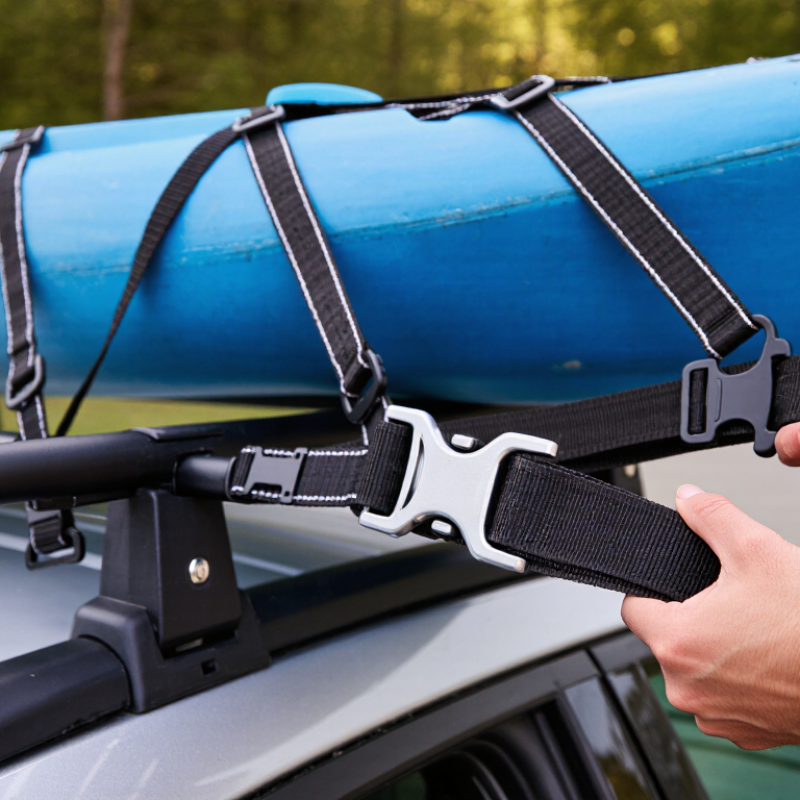
Cam straps secure a kayak by turning hand pressure into steady tension across the hull. At the roof rack, pass each strap over the kayak and around a crossbar. Keep the buckle beside the hull, with a cloth layer underneath. Pull until the boat cannot slide, then stop; too much tension can dent a plastic hull.
Small details matter. A twisted strap may rub against the boat, while a buckle resting on the roof can scratch it. Check that the straps lie flat and do not press on fragile fittings.
Add separate bow and stern tie-downs to limit movement in crosswinds or during sudden braking. After a short drive, recheck the cam straps; webbing and padding can settle as the load shifts.
The AAA Foundation for Traffic Safety’s 2016 report, Crashes Involving Road Debris, estimated about 200,000 debris-related crashes between 2011 and 2014. It also estimated 39,000 injuries and 500 deaths. These figures cover road debris broadly, not kayak straps, but they underline why loose loads deserve attention. A strap can feel secure in the driveway and still loosen with vibration, so inspect the setup again at each stop.
What Are the Best Cam Straps for Kayaks?
Key Features That Affect Strap Strength and Ease of Use
Strap strength depends on more than a heavy-looking buckle. Check the webbing for tight, even weaving and sturdy stitching, especially where it joins the buckle. Polyester webbing generally stretches less when wet than nylon, which can help keep a kayak secure. Small details matter. A buckle should move smoothly, hold tension, and have edges that will not cut into the strap. Wider webbing can spread pressure across the hull, but it must fit the buckle properly.
Ease of use becomes obvious with cold or damp hands. Look for a release tab you can press without pinching your fingers, and choose a strap long enough to pass over the kayak and around the rack without awkward knots. Feel the difference. Before driving, tighten the strap until the kayak cannot shift, but avoid crushing a plastic hull; too much pressure can cause damage. There is no perfect setup for every hull. Strap length is easy to misjudge, even when the buckle feels solid. Check for fraying, bent buckles, or slipping after the first short trip, then inspect them regularly.
| Feature | What to Look For | Effect on Strength and Security | Effect on Ease of Use | Practical Selection Tip |
|---|---|---|---|---|
| Strap material | Woven polyester webbing is commonly used for outdoor tie-down straps. | Webbing quality, condition, and the strap’s rated capacity matter more than the material name alone. Polyester generally stretches less and absorbs less moisture than nylon. | Flexible webbing is easier to route around a kayak and through roof-rack attachment points. | Choose webbing with a clearly stated capacity and inspect it for cuts, fraying, or damaged stitching. |
| Strap width | One-inch webbing is a common size for kayak cam straps; wider options are also available. | Width alone does not establish load capacity. Capacity depends on the complete assembly, including webbing, stitching, and buckle. | Confirm that the webbing fits the buckle and the attachment points on your rack. | Use a width that fits your rack system and kayak without twisting or bunching. |
| Cam buckle | A smooth-operating, corrosion-resistant buckle with a spring-loaded cam that grips the webbing. | The buckle and its connection to the webbing contribute to the strength of the complete strap assembly. | A cam buckle can be released and tightened by hand, without a separate tool. | Test the buckle before loading: it should grip securely and release without sticking. |
| Rated capacity label | Look for a legible working load limit (WLL) or other clearly defined capacity information. | Use the rating for the complete strap assembly. Breaking strength is not the same as a working load limit. | A clear label makes it easier to compare straps and follow the maker’s instructions. | Do not infer a safe capacity from strap width, appearance, or an unlabeled breaking-strength figure. |
| Stitching and hardware attachment | Even, intact stitching with no loose threads, pulled seams, or sharp hardware edges. | Damaged seams or attachment points can weaken the strap even when the webbing looks sound. | Flat, tidy stitching is less likely to snag while threading the strap. | Check the buckle-to-webbing connection before every trip and replace a strap with damaged stitching. |
| Strap length | A length suited to the kayak, rack spacing, and the route around the hull and rack bars. | Length does not increase the strap’s rated capacity, but an unsuitable length can make secure routing difficult. | Extra length may need to be managed; a strap that is too short may not reach safely around the load. | Measure the path around your kayak and rack, allowing enough length to thread and secure the tail. |
| Protective contact points | Smooth webbing and, where needed, a soft protective sleeve or separate padding at contact points. | Protection can reduce abrasion between the strap and kayak, but it does not raise the strap’s load rating. | Padding may take a little longer to position but can help protect the hull’s finish. | Keep the webbing flat and avoid placing a hard buckle directly against the kayak. |
| Ease of tensioning | A cam buckle that can be tightened by hand with controlled pressure. | Excessive tension can deform or damage some kayak hulls; a stronger strap does not make overtightening safe. | Cam straps allow quick adjustment and are easy to loosen at the end of a trip. | Tighten until the kayak is secure, not until the hull visibly flexes. |
| Weather and wear resistance | Webbing and hardware intended for outdoor use, with no corrosion, brittleness, or fading that signals deterioration. | Sun exposure, grit, moisture, and repeated abrasion can degrade straps over time. | Rinsing off grit and drying straps before storage helps keep them easier to operate. | Store straps out of prolonged direct sunlight and replace any strap showing significant wear. |
| Fit with the transport setup | A strap arrangement compatible with the rack, crossbars, and kayak shape. | Secure attachment depends on routing and anchoring the straps correctly, not just on the strap’s capacity. | Simple, repeatable routing makes pre-trip checks faster. | Follow the rack and kayak manufacturers’ instructions, and recheck the straps after driving a short distance. |
Safety note: There is no single strap rating that is best for every kayak and rack setup. Follow the capacity and installation instructions for your equipment, secure the kayak at appropriate points, and check that it remains stable before travel.
Strap material affects stretch, weathering, and handling. Polyester webbing generally stretches less than nylon and resists moisture-related changes, making it a practical choice for roof transport. Nylon can feel softer and absorb more water, while polypropylene is lightweight but may age faster under strong sunlight. Check the webbing’s stated working-load limit, not just its breaking strength. They are not the same.
Length matters as much as material. Measure around the kayak and roof bars, then allow enough tail to thread the buckle without leaving a long, flapping end. A 12-foot strap may suit many roof setups, but wide boats or tall vehicles can need more. Too much excess is awkward. Too little is worse. For road-force context, Australia’s National Transport Commission Load Restraint Guide (2018) uses design forces of 0.8 g forward and 0.5 g sideways or rearward for general load restraint. Those figures are not kayak-specific, but they underline why snug, correctly routed straps matter.
Buckle design changes how easily you can tension and release a load. Cam buckles allow quick adjustment and avoid the high leverage of ratchet mechanisms, which can crush a kayak if overtightened. Look for rounded edges and a release tab that stays accessible beside the roof bar. ASTM D6775 describes testing methods for textile webbing strength; it does not certify every strap for kayak transport. A useful detail to inspect. After a short drive, recheck tension—though this step is easy to forget.
Choosing cam straps starts with your kayak and vehicle, not a product label. Measure the distance around the kayak and roof rack, allowing enough length for a secure wrap without a long, loose tail. Wider straps spread pressure across the hull, while narrow straps may suit compact boats. Check that the buckle closes smoothly and sits clear of the kayak’s surface. Fit matters.
Confirm your vehicle’s roof-rack instructions and weight limits before loading. Place the kayak on padded supports, then route each strap over the hull and under the rack’s crossbar. Keep straps flat, with no twists. Pull them snug, but do not crush the hull; plastic and composite kayaks respond differently to pressure. A firm hand check is more useful than simply pulling harder. Check twice.
Cam straps are useful for straightforward tie-downs, but the best setup depends on the rack layout and travel conditions. Add bow and stern lines when appropriate, securing them to suitable points on the vehicle rather than fragile trim. After a short drive, stop somewhere safe and check for shifting or slack. I have found that a setup that looks tidy at home can loosen on the road, especially when straps settle around curved hulls. Recheck them before continuing, and replace straps with damaged webbing or unreliable buckles.
What Are the Best Cam Straps for Kayaks?
Safe Techniques for Tightening and Checking Cam Straps
For kayak transport, choose cam straps with flat, durable webbing and a buckle that releases smoothly. Match strap length to your kayak and roof rack, and follow the rack and strap instructions. Lay each strap over the kayak and crossbar without twists. Keep the buckle reachable and away from sharp edges. A snug fit is enough; excessive force can dent or stress some hulls.
Thread the strap through the buckle as directed, then pull the free end until the kayak feels secure. Fasten the loose tail so it cannot flap in the wind. Feel the hull. Press down gently and try shifting the kayak side to side. It should not slide on the crossbars. Then tug again. Check that the buckles remain closed and the straps have not loosened. Recheck after a short drive, since straps can settle. I sometimes find a strap looks tight but still allows a little movement, so trust the physical check more than appearance.
Tips: Keep straps clear of cockpit openings and sharp fittings. Avoid knots in loaded webbing. If the strap is frayed, cut, or difficult to release, replace it before travel. A quick check at each stop is worth the extra minute.
A practical recheck schedule for a kayak secured to a roof rack. The times are reminders, not universal standards; follow your vehicle and rack instructions, and check again at every stop.
Safe technique: Tighten each strap until the kayak is held firmly without crushing or deforming it. Check for twists, worn webbing, and secure buckles; confirm the kayak cannot shift, then recheck after the straps settle.